Last updated: March 2026
Your L2 is live. Contracts are deployed. Your community needs a block explorer before the week is out. Building one from scratch means hiring a separate engineering team. Etherscan’s EaaS waitlist could take weeks. Blockscout’s self-hosted setup requires DevOps capacity you may not have.
We built Ethernal to solve this problem for our own projects. This comparison includes Ethernal alongside the major alternatives. We’re biased, obviously. But we’ll be upfront about it, and we will be transparent about where each tool fits best and where it falls short.
One thing most comparison guides get wrong: they mix up “explorers for reading public chains” with “explorers you can deploy for your own chain.” Those are different decisions with different criteria. Etherscan is great for looking up transactions on Ethereum mainnet. It tells you nothing about how to run an explorer for the L2 you just launched. This guide covers both categories but focuses on the second one, because that’s the decision most teams are actually stuck on.
What you’ll get: a structured comparison of six block explorers with real pricing, honest assessments of limitations, and a decision framework for teams at different stages.
Key takeaways
- Block explorers are infrastructure, not optional. Users, developers, and auditors all depend on them.
- Open-source explorers (Ethernal, Blockscout) eliminate vendor lock-in and let you self-host.
- Setup speed varies wildly: under 5 minutes (Ethernal) to weeks (custom Etherscan EaaS).
- Full white-label branding starts at $500/mo with Ethernal. Partial customization (custom domain, no ads) from $150/mo.
- Self-hosting via Docker under an MIT license is the most cost-effective path for data sovereignty.
- Etherscan remains the gold standard for Ethereum mainnet, but it’s closed-source and expensive.
- No single explorer fits every use case. Your chain type, budget, and team size determine the right pick.
What to look for in a block explorer
A block explorer is a search and analytics interface that lets users inspect transactions, blocks, addresses, and smart contracts on a blockchain. Choosing the right one depends on a handful of practical criteria that matter once real users start interacting with your chain. MilkRoad published an evaluation covering several of these points1, and QuickNode’s builders guide ranks explorers by similar criteria10. We’ve expanded the list based on what we hear from teams deploying EVM chains in production.
Open-source status determines whether you can audit, fork, and extend the explorer. For teams building on custom EVM chains, proprietary explorers create vendor lock-in. If the provider changes pricing or discontinues your chain, you have no fallback. This isn’t hypothetical: it happened to Avalanche when Etherscan pulled Snowtrace2.
Setup speed is how long it takes from “we need an explorer” to “our community can verify transactions.” Some explorers deploy in minutes from an RPC URL. Others require weeks of infrastructure provisioning and back-and-forth with a sales team. We’ve seen teams delay public launches because their explorer wasn’t ready.
Self-hosting gives teams full control over their data. For enterprise chains and permissioned networks, sending transaction data to a third-party hosted service may not be acceptable. Self-hosting via Docker lets teams run the explorer on their own infrastructure.
White-label branding means your explorer uses your domain, logo, colors, and theme. Users should see your brand, not the explorer provider’s. The depth of customization varies: some providers allow only a logo swap, others give you full theme control.
Transaction tracing provides full call traces, state diffs, and event logs for debugging failed transactions. This is the feature developers use most. Without it, debugging reverted transactions means writing custom scripts to replay execution.
Contract verification lets developers submit Solidity or Vyper source code and match it against deployed bytecode. Verified contracts can be read and interacted with directly from the explorer. CI/CD integration matters for teams deploying contracts frequently.
API access allows wallets, DEXs, bridges, and analytics tools to pull data from your explorer programmatically. Etherscan-compatible API endpoints are the de facto standard, and most ecosystem tooling expects them.
Pricing transparency matters because block explorer costs can range from $0 (self-hosted open source) to over $1 million per year for enterprise EaaS contracts2. Hidden fees, usage-based overages, and opaque “contact sales” pricing make budgeting difficult.
The best block explorers for EVM chains in 2026
1. Etherscan
Etherscan is the original EVM block explorer and remains the industry standard for Ethereum mainnet. Founded in 2015, it has become one of the most trusted names in blockchain infrastructure3.
Strengths:
- Brand recognition that nothing else comes close to. When people say “check Etherscan,” they mean “check the block explorer.” If your chain uses their EaaS product, that name recognition carries over.
- The Etherscan group operates over 20 chain-specific explorers including BscScan, PolygonScan, and Optimistic Etherscan.
- Etherscan-compatible API has become the de facto standard that other explorers replicate. Years of tooling built around it.
- Contract verification is the industry standard. Most developers verify on Etherscan first.
Limitations:
- Closed-source. You cannot audit, fork, or self-host the code.
- EaaS pricing is opaque. When Snowtrace (Avalanche’s Etherscan-powered explorer) was discontinued in 2023, CoinTelegraph reported that annual subscription costs of $1-$2 million per year were cited as a contributing factor2.
- Customization is limited compared to open-source alternatives. White-label options exist but within fixed templates.
Best for: Teams that need the most recognized explorer brand for Ethereum mainnet or major L1s, and have the budget for enterprise pricing.
Pricing: Free to browse public explorers. API plans from $0 (free tier) to $399/mo for premium access. EaaS is custom-priced (contact sales).
If you’re evaluating Ethernal as an Etherscan alternative for your custom chain, read the full Etherscan alternative comparison.
2. Blockscout
Blockscout is the largest open-source block explorer for EVM chains. It supports over 1,000 networks and is used by major ecosystems including Ethereum, Optimism, Arbitrum, Base, and Gnosis4.
Strengths:
- Fully open-source with a large contributor community.
- Supports L1, L2, L3, optimistic rollups, and ZK rollups. If a chain runs an open-source explorer, there’s a decent chance it’s Blockscout.
- Autoscout allows one-click deployment of a branded explorer with hosting included.
- Strong multichain search with a unified interface across supported networks.
Limitations:
- Self-hosted setup is not trivial. You’re dealing with an Elixir/Erlang runtime, nodes, indexers, and a frontend. If you don’t have someone on the team who enjoys that kind of thing, budget a few days.
- The ecosystem is large but navigating setup documentation can be complex for smaller teams.
Best for: Teams that want a battle-tested open-source explorer with the largest ecosystem and have the DevOps capacity for self-hosting, or prefer their managed Autoscout service.
Pricing: Free for self-hosted deployments. Autoscout and EaaS have paid tiers with usage-based pricing. Pro API plans available.
For a full side-by-side comparison including setup, architecture, and pricing, see Ethernal vs Blockscout.
3. Ethernal
Open-source (MIT licensed) block explorer built for fast deployment on any EVM chain. Paste an RPC URL and get a fully featured explorer running in minutes. We power 2,600+ public explorers across 370+ unique EVM chains, with 13,000+ users5.
Strengths:
- MIT licensed and fully open source on GitHub. Fork it, extend it, self-host it. No restrictions.
- Deploys in under 5 minutes from a single RPC URL. No complex infrastructure provisioning. Clone the repo, run
make start, and your explorer is running. - Full white-label branding: custom domain, logo, colors, and theme from the App Chain tier.
- Native L2 bridge support for Arbitrum Orbit and OP Stack chains, including deposit tracking, withdrawal claims, and batch monitoring.
- Transaction tracing with full call traces, state diffs, and event logs.
- Etherscan-compatible API endpoints, so existing tooling works out of the box.
- Contract verification through UI, API, and CLI (for CI/CD pipelines).
Limitations:
- EVM-only. Does not support non-EVM chains like Solana, Bitcoin, or Cosmos.
- Smaller ecosystem than Blockscout. We’re getting there, but Blockscout has a multi-year head start.
- Self-hosted version is in beta, as noted in the GitHub repository.
Best for: Teams shipping L2s, app chains, or testnets that need a working explorer fast, with full control over data and no vendor lock-in. Particularly strong for solo developers on Hardhat/Anvil who need a local chain explorer, and for startups that need white-label branding without enterprise pricing.
Pricing: Transparent, published tiers. $0 self-hosted (MIT license). $0 Starter (hosted, ad-supported, Ethernal branding). $150/mo Team (custom domain, no ads, L2 bridge support, 100k transactions included). $500/mo App Chain (full white-label, custom branding, 5M transactions included). Enterprise is custom-priced. See pricing.
4. Tenderly
A full-stack development platform for EVM chains that includes a Developer Explorer alongside debugging, simulation, and monitoring tools6.
Strengths:
- The best transaction debugging and simulation tool we’ve used. Tenderly’s trace visualizer is excellent.
- Developer Explorer provides decoded, human-readable insights specific to your dapp’s contracts.
- Transaction simulation lets you preview outcomes before sending onchain. Saves gas, prevents costly mistakes.
- Supports 109+ blockchain networks7.
- Virtual TestNets provide isolated staging environments with mainnet data.
Limitations:
- Not a traditional public-facing block explorer. Tenderly is designed for development workflows, not for end users browsing your chain. You still need a separate public explorer.
- Closed-source and not self-hostable. Your data lives on Tenderly’s infrastructure.
Best for: Development teams that need deep transaction debugging, simulation, and monitoring. Use alongside a public explorer, not as a replacement.
Pricing: Free tier available with usage limits. Paid plans for teams. Contact sales for enterprise.
5. Blockchair
A multi-chain search engine and analytics platform supporting over 40 blockchains, including both EVM and non-EVM chains like Bitcoin, Litecoin, and Monero8.
Strengths:
- Broadest chain coverage of any explorer, spanning EVM and non-EVM ecosystems.
- Advanced search with SQL-like query capabilities for filtering, sorting, and aggregating blockchain data.
- Privacy-first approach: does not track users or share data with third-party analytics.
- Cross-chain analytics and portfolio tracking without account creation.
Limitations:
- Cannot host a branded explorer for your own chain. Blockchair is a public search tool, not an EaaS provider. If you’re launching a new chain, it won’t help.
- No transaction tracing, contract verification, or debugging tools.
Best for: Researchers, analysts, and users who need to investigate transactions across multiple chains from a single interface.
Pricing: Free to browse. API pricing is pay-as-you-go based on call volume.
6. Routescan
A unified multichain explorer that provides EaaS for EVM chains. It powers explorers for ecosystems including Avalanche, Flare, Chiliz, and Taiko9.
Strengths:
- Unified explorer covering 160+ blockchains with a clean interface.
- Etherscan-compatible API format, making it easy for developers to migrate existing integrations.
- 48-hour explorer setup for new chains.
- Free API tier available (2 requests/second, 10,000 daily calls) without requiring an API key.
Limitations:
- Closed-source. You cannot self-host or audit the code.
- Customization is limited compared to open-source alternatives.
- Newer entrant with a smaller track record than Etherscan or Blockscout.
Best for: Teams in the Avalanche ecosystem or those that want a managed multichain explorer with moderate customization and straightforward API access.
Pricing: Paid EaaS with flexible pricing. Free API tier available. Contact sales for custom explorer deployments.
For teams weighing Routescan for Avalanche L1s or Subnets, the Routescan alternative page walks through the trade-offs in detail.
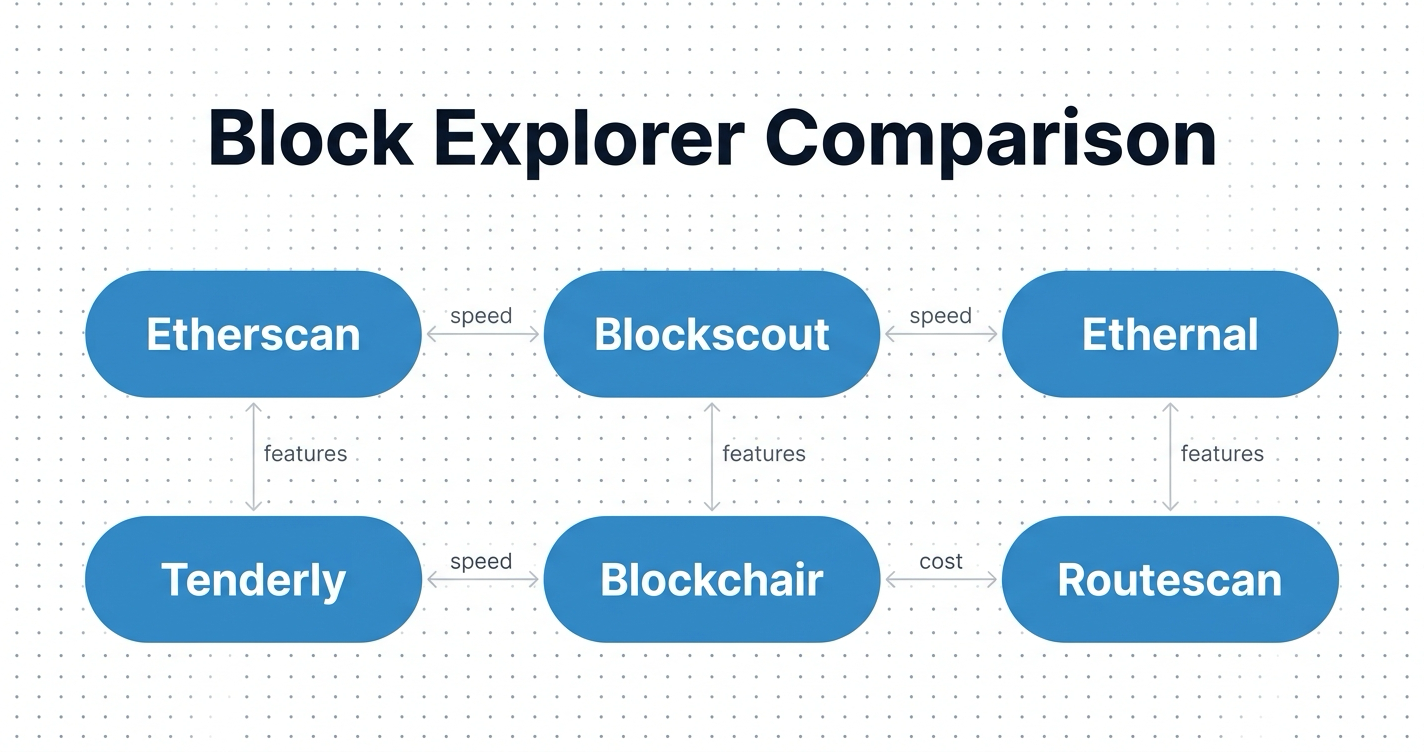
Block explorer comparison
Same criteria, all six explorers, one table.
| Criteria | Etherscan | Blockscout | Ethernal | Tenderly | Blockchair | Routescan |
|---|---|---|---|---|---|---|
| Open source | No | Yes (Elixir) | Yes (MIT) | No | No | No |
| Setup time | Weeks (EaaS) | Minutes (Autoscout) / Days (self-hosted) | Under 5 minutes | Minutes (dev explorer) | N/A (public tool) | Around 48 hours |
| Self-hostable | No | Yes | Yes (Docker) | No | No | No |
| White-label | Limited | Full | Full (from $500/mo) | N/A | N/A | Moderate |
| EVM chain support | L1, select L2s | L1, L2, L3, ZK rollups | L1, L2, local dev, custom EVM | 109+ EVM networks | 40+ chains (EVM + non-EVM) | 160+ chains |
| Transaction tracing | Basic | Full traces | Full traces | Advanced (best-in-class) | None | Basic |
| Contract verification | Solidity, Vyper | Solidity, Vyper | Solidity, Vyper (UI/API/CLI) | Solidity, Vyper | None | Solidity |
| API access | Free + paid tiers | Free + Pro API | Included in all plans | Included in platform | Pay-as-you-go | Free tier + paid |
| Starting price | Free (browse) / EaaS: custom | Free (self-hosted) / EaaS: paid tiers | $0 (self-hosted) / $150/mo (Team) / $500/mo (white-label) | Free tier / paid plans | Free (browse) / API: paid | Free API tier / EaaS: paid |
This table reflects publicly available information as of March 202611. Pricing and features change; verify with each provider before making a decision.
How to choose the right explorer for your chain
The right block explorer depends on your chain type, team size, and budget. We see the same five scenarios over and over.
Solo developer on Hardhat or Anvil: Use Ethernal’s free tier or Tenderly’s Developer Explorer. Both connect to local chains and provide transaction visibility without infrastructure setup. Ethernal gives you a visual explorer; Tenderly gives you debugging and simulation.
Startup shipping a testnet explorer: Ethernal Team ($150/mo) or Blockscout’s Autoscout. Ethernal is faster to set up from a single RPC URL. Blockscout has a larger ecosystem. Both give you custom domains.
L2 or app chain needing a white-label production explorer: Ethernal App Chain ($500/mo), Blockscout EaaS, or Etherscan EaaS. Ethernal has the lowest published starting price for full white-label. Blockscout provides the deepest open-source customization. Etherscan provides the strongest brand recognition but at significantly higher cost.
Multi-chain analytics and investigation: Different category entirely. Blockchair for cross-chain research across EVM and non-EVM chains. Routescan for unified EVM chain browsing. Neither hosts an explorer for your own chain.
Enterprise or private/permissioned chain: Data sovereignty and permissioned access matter here. Ethernal self-hosted (MIT license) or Blockscout self-hosted give you full control. For enterprise-specific analytics and compliance features, Chainlens (formerly Epirus) is purpose-built for private EVM networks. Etherscan Enterprise works if brand trust is the priority and budget isn’t a constraint.
Still weighing self-hosted open source against a fully managed EaaS, or wondering whether to staff an in-house team? For the full infrastructure cost breakdown, read the Build vs Buy comparison.
| Use Case | Recommended Explorer | Why |
|---|---|---|
| Local dev chain | Ethernal (free) or Tenderly | Fast setup, no infrastructure needed |
| Testnet explorer | Ethernal Team ($150/mo) or Blockscout Autoscout | Custom domain, quick deployment |
| Production white-label (L2/app chain) | Ethernal App Chain ($500/mo), Blockscout EaaS, Etherscan EaaS | Full branding, production-grade |
| Cross-chain research | Blockchair | 40+ chains, SQL-like queries |
| Enterprise / private chain | Ethernal or Blockscout (self-hosted), Chainlens | Data sovereignty, permissioned access |
| Enterprise L1 (public) | Etherscan Enterprise or custom Blockscout | Brand trust or full control |
One more thing: these categories aren’t mutually exclusive. Plenty of teams use Ethernal or Blockscout as their chain’s public explorer while also using Tenderly for internal debugging.
Try it: deploy an explorer in 5 minutes
Most comparison articles stop at the table. This is the actual setup process for self-hosting Ethernal.
Prerequisites: Docker and Docker Compose, OpenSSL, and a domain name or server IP.
Step 1: Clone and start.
git clone https://github.com/tryethernal/ethernal.git
cd ethernal
git checkout $(git describe --tags --abbrev=0)
make start
make start does everything on first run: prompts you for your domain or IP address, generates all required environment files (including secrets and database credentials), pulls Docker images, and starts all services (PostgreSQL, Redis, the backend, the frontend, and the sync workers). No manual configuration files to edit.
Step 2: Configure your chain.
Visit http://your-domain-or-ip/setup in your browser. Paste your chain’s RPC URL. The explorer connects, starts indexing blocks and transactions, and you’re live.
Terminal output when installation finishes:
==================== Ethernal Installation Complete! ====================
  Start here to setup your instance:
    http://your-domain-or-ip/setup
=======================================================================
Under 5 minutes from clone to a working explorer. We’ve timed it.
From there, point your DNS for a custom domain (SSL is automatic), upload your logo and chain branding, and enable contract verification for your developers. Start on the free Starter plan and upgrade to Team or App Chain when you need white-label features.
The MIT license means you can also fork the repo and modify anything. No license restrictions, no attribution requirements beyond keeping the license file.
Frequently asked questions
What is the best blockchain explorer?
The best block explorer depends on your use case. Etherscan is the gold standard for Ethereum mainnet browsing. Blockscout is the leading open-source option with the broadest chain support. Ethernal offers the fastest deployment for custom EVM chains with full white-label and self-hosting capabilities. For cross-chain analytics, Blockchair covers the most networks.
Are blockchain explorers free to use?
Most public block explorers like Etherscan and Blockchair are free to browse. For hosting your own explorer, costs range from $0 (Ethernal self-hosted or Blockscout open-source deployment) to custom enterprise pricing with Etherscan EaaS. Ethernal’s hosted plans start at $0 (Starter) and go up to $500/mo for full white-label.
What is a block explorer as a service (EaaS)?
Block explorer as a service (EaaS) is a managed hosting model where a provider deploys, maintains, and scales a branded block explorer for your chain. Providers include Etherscan, Blockscout, Ethernal, and Routescan. EaaS removes the need to run your own infrastructure but may limit customization compared to self-hosted open-source deployments.
Which blockchain explorers support white-label branding?
Etherscan EaaS offers limited white-label customization within fixed templates. Blockscout provides full white-label control in both self-hosted and managed deployments. Ethernal offers full white-label branding (custom domain, logo, colors, theme) starting at $500/mo on the App Chain plan. Routescan offers moderate customization through its EaaS offering. In practice, “white-label” means your users see your brand, not the explorer provider’s.
Can I self-host a block explorer?
Yes. Ethernal (MIT license) and Blockscout (open source) both support self-hosting. Ethernal can be deployed via Docker with git clone and make start. Blockscout requires more infrastructure setup (Elixir runtime, multiple services) but offers deeper customization once running. Self-hosting gives you full control over your data but means you handle maintenance, scaling, and updates yourself.
What is the best Ethereum explorer?
For browsing Ethereum mainnet, Etherscan is the most established Ethereum explorer and the one most users mean by “the ether explorer.” For running your own explorer on an Ethereum L2 or app-chain, Ethernal and Blockscout are the strongest options because both are open-source and let you point an explorer at any EVM RPC URL. The right Ethereum explorer depends on whether you are reading a public chain or operating one of your own.
What is a multi-chain explorer?
A multi-chain explorer is a single block explorer that indexes and serves data for many blockchains at once, so you can search transactions and addresses across several chains from one interface. Blockscan (the Etherscan group’s multi-chain view) and Routescan are common hosted examples. If you run several EVM chains yourself, Ethernal lets you spin up a chain explorer per network and manage them from one account, which is the self-hosted equivalent of a multi-chain explorer.
What is a chain explorer?
A chain explorer, also called a block explorer, is the search and analytics interface for a single blockchain. It lets users look up blocks, transactions, addresses, tokens, and verified smart contracts for that chain. Every production EVM chain needs one so that users, developers, and auditors can verify on-chain activity. For a custom or unified chain explorer across your own networks, Ethernal deploys one from an RPC URL in under five minutes.
Key takeaways
- Every production EVM chain needs a block explorer. It is infrastructure, not optional.
- Open-source explorers (Ethernal, Blockscout) eliminate vendor lock-in and give teams full control over their data and customization.
- Setup speed varies dramatically: from under 5 minutes with Ethernal via RPC URL, to weeks for a custom Etherscan EaaS deployment.
- White-label block explorers start at $500/mo with Ethernal, compared to custom (often six-figure) pricing with Etherscan EaaS.
- Self-hosting via Docker (Ethernal, MIT license) is the most cost-effective option for teams that want data sovereignty without recurring SaaS fees.
- Etherscan remains the most trusted name for Ethereum mainnet but is closed-source and limited in customization for custom chains.
- No single explorer fits every use case. Match the tool to your chain type, team size, and budget using the decision framework above.
If you need a working explorer for your EVM chain today, try Ethernal free at tryethernal.com. Paste your RPC URL and have a working explorer in under 5 minutes.
Deep dives into specific alternatives
Each of the explorers above has its own detailed comparison page walking through setup, architecture, pricing, and the specific trade-offs:
- Ethernal vs Blockscout, open-source alternatives compared
- Etherscan alternative for custom EVM chains, when Etherscan isn’t an option
- Routescan alternative, open-source explorer for Avalanche L1s and beyond
- Build vs Buy: block explorer cost breakdown, real numbers on in-house vs Explorer-as-a-Service
References
1. MilkRoad. “Top 3 Block Explorer-as-a-Service Providers.” milkroad.com. https://milkroad.com/block-explorers-as-a-service/
2. CoinTelegraph. “Avalanche blockchain explorer to shut down as Etherscan fees draw controversy.” October 2023. https://cointelegraph.com/news/avax-blockchain-explorer-to-shut-down-etherscan-fees-draw-controversy
3. Etherscan. “Explorer as a Service.” etherscan.io. https://etherscan.io/eaas
4. Blockscout. Open-source block explorer documentation and chain list. blockscout.com. https://www.blockscout.com/
5. Ethernal. Block explorer for EVM chains. tryethernal.com. https://tryethernal.com/
6. Tenderly. “Developer Explorer.” tenderly.co. https://tenderly.co/developer-explorer
7. Tenderly. “Supported Networks.” docs.tenderly.co. https://docs.tenderly.co/supported-networks
8. Blockchair. Multi-chain block explorer. blockchair.com. https://blockchair.com/
9. Routescan. Multichain explorer and EaaS platform. routescan.io. https://routescan.io/
10. QuickNode. “Top 8 Block Explorers in 2026.” quicknode.com. https://www.quicknode.com/builders-guide/best/top-8-block-explorers
11. CryptoAdventure. “Best Multi-Chain Block Explorers in 2026.” February 2026. https://cryptoadventure.com/best-multi-chain-block-explorers-in-2026/