A MetaMask wallet (no smart contract deployed, no ERC-4337 setup, no wallet migration) submits a transaction. Its ETH balance is zero. It pays gas in USDC. The transaction goes through.
This is not a hypothetical. It is what EIP-8141’s “default code” mechanism enables for existing EOA addresses, without the account ever deploying a contract or touching a bundler.
EIP-8141 , co-authored by Vitalik Buterin, lightclient, Felix Lange, Yoav Weiss, Alex Forshtat, Dror Tirosh, and Shahaf Nacson , is the Ethereum core team’s proposal for protocol-native account abstraction, targeting the Hegota hard fork (H2 2026).1 An All Core Devs vote is scheduled for March 27, 2026. Unlike ERC-4337, it needs no bundlers, no separate mempool, no reputation system. Unlike EIP-8130’s verifier sandbox approach, it introduces new EVM opcodes and a fundamentally different execution model.
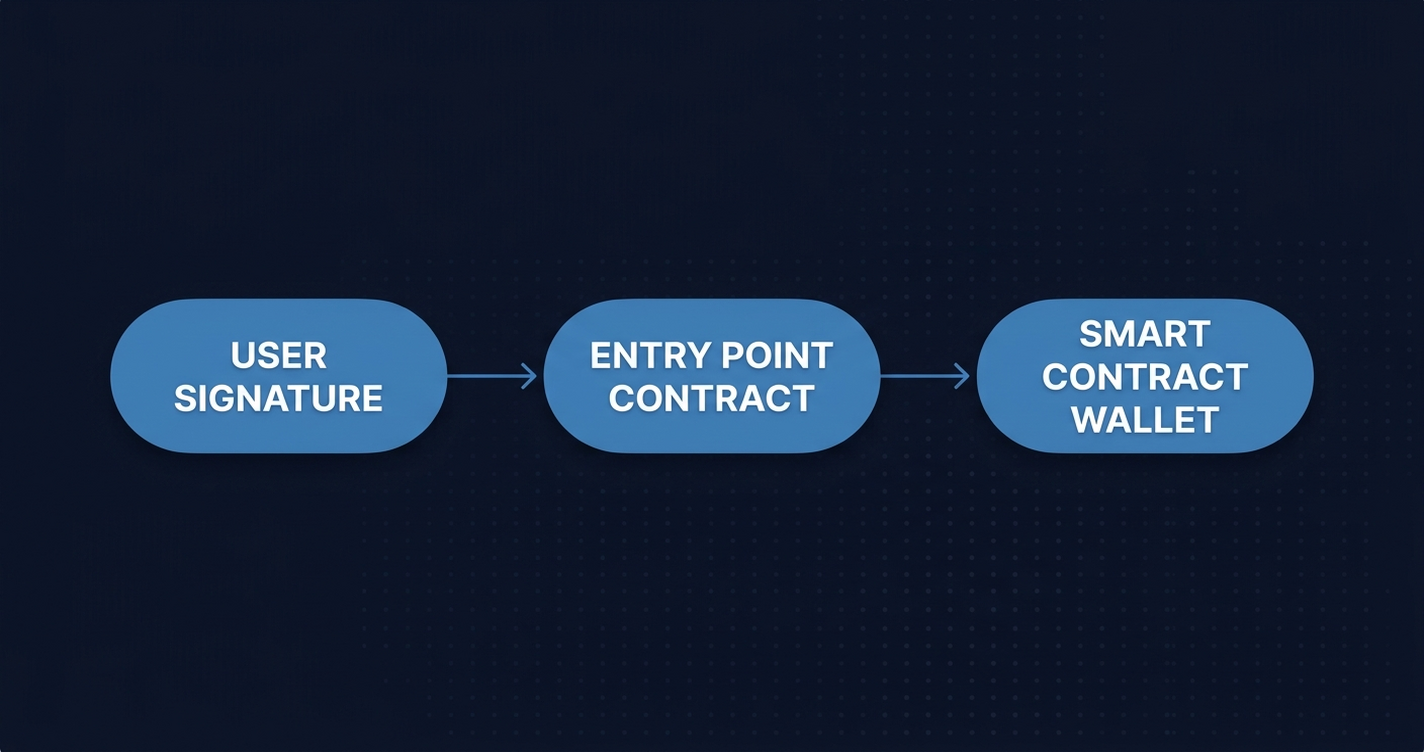
The core structure: a transaction is not a single call. It is a sequence of frames.
Why ERC-4337 cannot solve this at the protocol level
ERC-4337 achieved account abstraction without a hard fork , a genuine technical achievement. But its architecture created a structural dependency that protocol-level AA needs to eliminate.
Nodes must simulate arbitrary EVM to validate a UserOp before inclusion. That simulation requires full state access. A malicious UserOp can burn validation gas without any on-chain footprint , a natural denial-of-service vector. The solution was bundlers: trusted off-chain operators who bear the simulation cost, filter spam, and aggregate valid UserOps into regular transactions. Bundlers need a reputation system. The reputation system requires a separate mempool. The separate mempool means users depend on bundler liveness, not validator inclusion.
struct UserOperation {
    address sender;
    uint256 nonce;
    bytes initCode;
    bytes callData;
    uint256 callGasLimit;
    uint256 verificationGasLimit;
    uint256 preVerificationGas;
    uint256 maxFeePerGas;
    uint256 maxPriorityFeePerGas;
    bytes paymasterAndData;
    bytes signature;
}
The userspace design worked for mainnet UX. It cannot work as a protocol primitive: each chain runs an independent ERC-4337 deployment, bundler infrastructure availability varies, and the bundler trust model does not disappear with scale.
EIP-8141 asks a different question: what if validation is just EVM code running in a STATICCALL? No arbitrary simulation by nodes. The EVM handles the restriction. The node does not need to trust the simulation.
What a frame transaction actually is
EIP-8141 introduces transaction type 0x06. Instead of a single call target, a frame transaction carries a sequence of execution frames:
[chain_id, nonce, sender, frames, max_priority_fee_per_gas,
 max_fee_per_gas, max_fee_per_blob_gas, blob_versioned_hashes]

frames = [[mode, target, gas_limit, data, value], ...]
Each frame has its own mode, target, gas limit, calldata, and value. Unused gas does not transfer between frames , each frame either completes within its budget or reverts independently.
Three frame modes govern how execution works:
| Mode | Value | Execution | Requirement |
|---|---|---|---|
| DEFAULT | 0 | Regular call with ENTRY_POINT as caller | None |
| VERIFY | 1 | STATICCALL (no state changes) | Must emit APPROVE |
| SENDER | 2 | Call with account address as caller | Requires prior APPROVE |
The ENTRY_POINT address is 0xaa , same as the new APPROVE opcode, an intentional mnemonic.
EIP-8141 introduces three new opcodes to support this model:
APPROVE (0xaa): LikeRETURN, but sets a transaction-scope approval flag.scope=0x0grants execution rights,scope=0x1grants payment rights,scope=0x2grants both.TXPARAMLOAD (0xb0): Read transaction parameters by index (nonce, sender, sig hash, frame count, frame mode).TXPARAMSIZE (0xb1)/TXPARAMCOPY (0xb2): Read size and copy parameter data to memory.
A VERIFY frame runs as a STATICCALL , no state writes, no ETH transfers. It must call APPROVE before returning or the transaction fails. SENDER frames execute only after the relevant approval has been granted. This ordering guarantee is what makes the model safe: validation is provably read-only, execution follows only on explicit approval.
VERIFY frame data is also elided from the signing hash. This enables future signature aggregation: multiple users’ verification frames can share a single aggregated proof without changing the core protocol.
The gas model is explicit:
tx_gas_limit = 15,000 (intrinsic) + calldata_cost(rlp(frames)) + sum(frame.gas_limit)The 15,000 base is the same as EIP-8130’s AA_BASE_COST.
EOA default code: the sleeper feature
The most consequential addition to EIP-8141 came from PR #11379 by Derek Chiang.1 When a VERIFY frame targets an address with no deployed contract code, the EVM does not revert. Instead, it applies built-in default code.
The first byte of frame.data encodes the auth scheme: the high nibble is scope, the low nibble is signature_type:
0x0= secp256k1 ECDSA (standard Ethereum key)0x1= P256/secp256r1 (hardware security keys , Touch ID, Face ID, YubiKey)
On successful verification, the default code calls APPROVE(scope) automatically.
An unmodified EOA address , no contract, no migration, no wallet change , becomes VERIFY-capable through this mechanism. None of that changes: not the wallet software, not the signing key, not the address. The EOA gains gas abstraction because the EVM handles the verification natively when a VERIFY frame targets that address.
Here is what an EOA paying gas in ERC-20 looks like as a frame sequence:
| Frame | Caller | Target | Mode | Purpose |
|---|---|---|---|---|
| 0 | ENTRY_POINT | EOA address | VERIFY | secp256k1 default code → APPROVE(exec) |
| 1 | ENTRY_POINT | Sponsor contract | VERIFY | Sponsor validates fee commitment → APPROVE(pay) |
| 2 | EOA | ERC-20 contract | SENDER | transfer(sponsor, fees) |
| 3 | EOA | dApp contract | SENDER | Actual user call |
The EOA never deploys a contract. The wallet never changes. The signing scheme stays secp256k1. Frame 0 succeeds via default code. Frame 1 succeeds because the Sponsor contract called APPROVE(0x1). Frames 2 and 3 execute because both approvals are in scope.
The P256 path works identically with signature_type = 0x1. A hardware security key (Touch ID, Face ID, a FIDO2 YubiKey) generates a P256 key pair. The Ethereum address is derived as keccak256(qx||qy)[12:]. A VERIFY frame targeting that address with signature_type = 0x1 applies the P256 default code and validates against the hardware key. No smart contract required.
The post-quantum path is also designed in. A VERIFY frame can target any contract , the underlying proof system is the contract’s choice. NIST-standardized post-quantum schemes (Falcon, ML-DSA via FIPS 204, SLH-DSA via FIPS 205) can be deployed as verifier contracts and used in VERIFY frames without any further protocol changes. The frame model does not presuppose secp256k1.2
What block explorers need to handle
EIP-8141 changes the transaction receipt format in ways that are visible to anyone reading the chain:
receipt = [cumulative_gas_used, payer, [frame_receipt, ...]]
frame_receipt = [status, gas_used, logs]
The top-level payer field is new. It records who actually paid for gas , distinct from sender, who submitted the transaction. For sponsored transactions, these are different addresses. For self-paying EOAs, they are the same. The distinction is always explicit in the receipt.
The per-frame receipt array is the other structural change. A 4-frame transaction produces 4 independent receipts. Each has its own status, its own gas_used, and its own logs. A transaction where frame 2 reverts while frames 0, 1, and 3 succeed is not a “failed transaction” , it is a partial execution where the state changes from frames 0, 1, and 3 are permanent.
This matters for debugging. Consider a sponsored transaction where frame 0 (EOA VERIFY) succeeds, frame 1 (sponsor VERIFY) succeeds, frame 2 (ERC-20 fee transfer) succeeds, and frame 3 (the actual dApp call) reverts. The user’s fee is already paid. The dApp call is the only thing that failed. A single-status “reverted” label tells you nothing useful. Per-frame statuses tell you exactly where the execution stopped.
VERIFY frames can also generate logs , APPROVE events are the obvious case. These need to be decoded separately from execution logs emitted by SENDER frames.
For teams building or debugging sponsored transactions: the payer field is the starting point for every postmortem. It answers “who paid” before any call tree analysis. On L2s where gas sponsorship is common, this distinction appears in most high-value transactions. Ethernal’s per-phase status rendering , built for EIP-8130’s phase model , maps directly to frame receipt display. Each frame renders as a labeled execution segment with its own status badge, gas consumed, and decoded logs.
Status and what comes next
EIP-8141 is targeting the Hegota hard fork (H2 2026). An All Core Devs vote is scheduled for March 27, 2026 , three days from this article’s publication.3 The March 2026 ACD call delayed formal approval on one outstanding item: a DoS protection spec for VERIFY frame execution. EIP-7562-style opcode restrictions , the same sandboxing approach used in ERC-4337 validation , need to be specified for the VERIFY frame context before the proposal can advance.
Three account abstraction proposals are currently in Draft, each representing a different opinion on protocol complexity budget:4
| EIP | Author | New Opcodes | Primary Feature |
|---|---|---|---|
| EIP-8175 | Dragan Rakita (reth) | 0 | Ed25519, extensible tx capabilities |
| EIP-8130 | Chris Hunter (Coinbase) | 0 | Verifier sandbox, cross-chain key sync |
| EIP-8141 | Vitalik Buterin et al. | 3 | Frame execution model, EOA default code |
These are not competing implementations waiting for a merge decision. They represent genuinely different protocol complexity budgets. EIP-8175 adds nothing to the EVM , it is a pure transaction format change with extensible capability slots. EIP-8130 adds a system contract. EIP-8141 adds opcodes and a new execution mode. The ACD will choose one (or none) for Hegota.
ERC-4337 remains valid on L2s that do not adopt EIP-8141 , backward compatibility is explicit in the spec. For teams on ERC-4337 today: frame transactions are a future migration target, not an immediate breaking change. The UserOperation model continues to work. When EIP-8141 ships on a chain you care about, the migration path is removing the bundler dependency , the business logic in your smart account stays the same.
Block 21,847,291
Return to the opening scenario. A MetaMask EOA with zero ETH submits a transaction paying gas in USDC. It lands.
The block explorer shows a 4-frame transaction. Frame 0: VERIFY, 3,200 gas, APPROVE logged. Frame 1: VERIFY, 4,100 gas, APPROVE logged. Frame 2: SENDER, 24,000 gas, ERC-20 Transfer emitted. Frame 3: SENDER, 51,000 gas, function call succeeded. Payer: 0x3f91... (Sponsor contract). Sender: 0x7a2b... (the EOA).
EIP-8141 upgrades existing wallets to something they could not do before, without the user touching anything. The migration was handled at the protocol layer, in a VERIFY frame, by default code that existed before the user knew the feature existed. That is a genuinely different philosophy from every prior AA proposal: the user is the last person to find out.
References
1. Chiang, D. (@derekchiang). “Update EIP-8141: Add EOA support.” GitHub EIPs, March 5, 2026. https://github.com/ethereum/EIPs/pull/11379
2. Openfort. “What EIP-8141 Means for Developers.” openfort.io, 2026. https://www.openfort.io/blog/eip-8141-means-for-developers
3. Ethereum Foundation. “Protocol Priorities Update 2026.” blog.ethereum.org, February 18, 2026. https://blog.ethereum.org/en/2026/02/18/protocol-priorities-update-2026
4. Rakita, D. (@rakita). “Add EIP: Composable Transaction.” GitHub EIPs, February 26, 2026. https://github.com/ethereum/EIPs/pull/11355