Your lending protocol just detected something. The largest collateral position on the platform was topped up: 10,000 ETH in a single transaction. TVL spikes. Directional risk spikes with it. The risk management system wants to hedge: short ETH perps until the position normalizes.
A Uniswap swap won’t work. That’s a market order with no size control. A CoW Protocol intent would improve the price, but it still settles as a market order within seconds. What the protocol actually needs is a limit order at a specific price, left working for hours, that the contract can cancel if the position closes or conditions change.
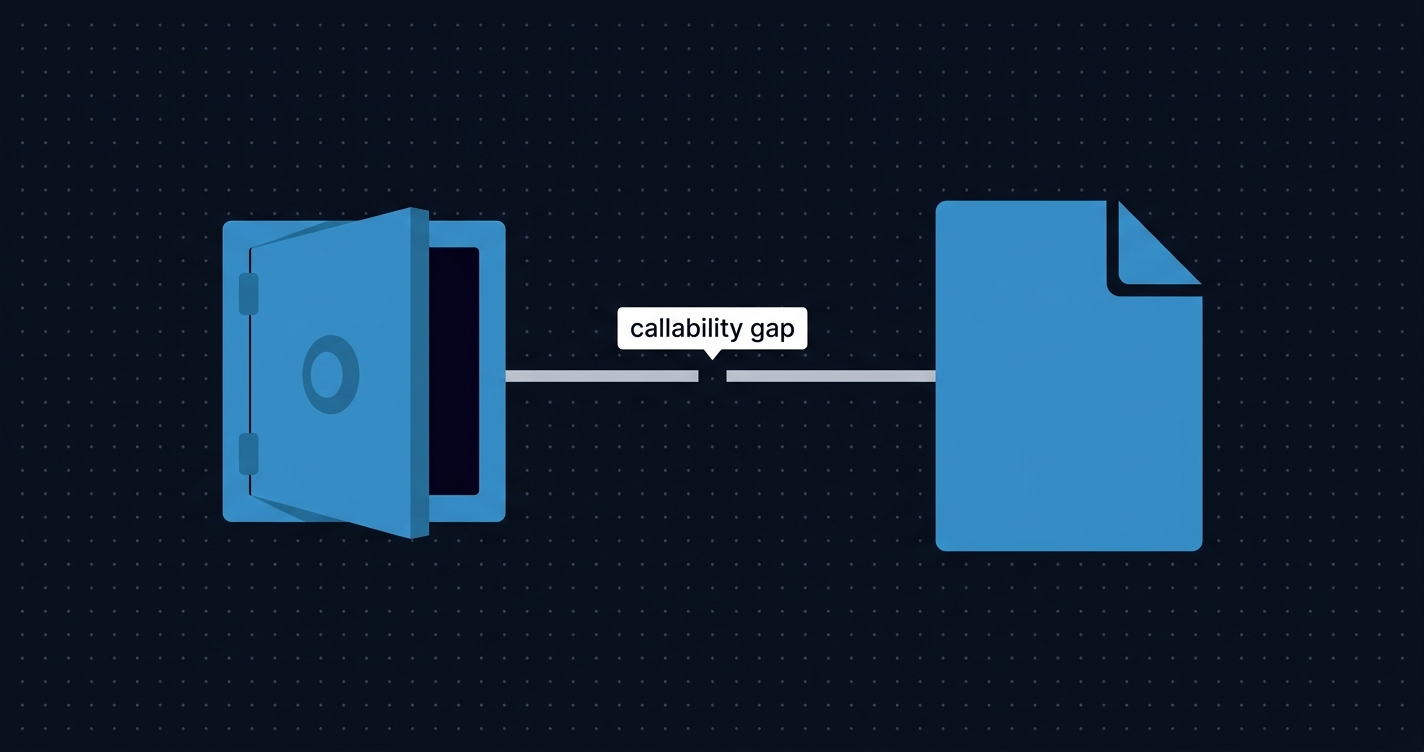
That interaction is not possible on-chain today. You need a human, a bot with a private key, or a CEX API. A proposal published in February 2026 on Ethereum Research argues all three are wrong answers, and introduces a pattern called DeCeFi to replace them.
What contracts can and cannot do
The past two years produced real improvements in on-chain execution quality. The intents and solvers ecosystem (CoW Swap, Uniswap X, 1inch Fusion) processed $10.5 billion in volume in January 2025 alone, roughly 12% of Ethereum DEX volume.2 Solvers compete to fill user orders at better prices than direct AMM swaps, with MEV protection built in via delegated execution.
But intents still produce market orders. The solver finds the best price available right now and settles. The result is better price execution. The capability set has not changed.
Smart contracts today can:
- Call other contracts synchronously
- Trigger AMM swaps with immediate settlement
- Emit intents that solvers fill at market
- Receive callbacks from oracle systems (Chainlink price feeds, VRF)
Smart contracts today cannot:
- Place a limit order on an order book and leave it working
- React to a partial fill and adjust position size
- Hold a perpetual futures position across multiple blocks
- Cancel an order when an on-chain condition changes
These missing capabilities require state persistence across blocks, conditional execution, and continuous position management. None of them can be delegated to a solver auction. All of them currently require a human or an EOA-controlled bot with a private key, breaking on-chain composability and introducing an off-chain trust assumption at the protocol layer.
This is not an AMM algorithm problem. It is what 0x1cc, the author of the DeCeFi proposal, calls the callability problem: high-performance trading engines cannot be invoked by smart contracts.1
The DeCeFi architecture
In February 2026, 0x1cc posted “What If Smart Contracts Could Trade on Binance? Introducing the DeCeFi Paradigm” on Ethereum Research.1 The core framing: treat trading engines as callable infrastructure, the same relationship smart contracts have with Chainlink oracles, rather than isolated venues.
The architecture has two layers.
Deterministic trading engine
A state machine that guarantees identical outputs from identical inputs. All actions (order placement, cancellation, position updates, liquidations) route through a single pipeline with unified liquidity access. Determinism is what makes the execution result provable.
The reference implementation is 128.trade, which positions itself as trading infrastructure rather than a venue: a callable execution engine that other protocols build on.
Oracle-style execution gateway
This is where the novel engineering lives. The flow has five steps:
- On-chain: the contract emits a canonical request event with execution parameters and a
requestId. - Off-chain: decentralized relayers validate the request and route it to the trading engine.
- Off-chain: the engine processes the order deterministically and produces a verifiable result.
- Off-chain: relayers construct a cryptographic proof bundle confirming execution.
- On-chain: the gateway verifies the proof and materializes the state change, positions, balances, order status.
The code pattern is immediately familiar to anyone who has built with Chainlink VRF:
// Step 1: emit a request to the execution layer
function placePerpOrder(PerpOrderParams calldata params)
    external payable returns (bytes32 requestId) {
    requestId = oracle.submitRequest{value: msg.value}(params);
    return requestId;
}

// Step 5: receive the verified result from the gateway
function onPlacePerpOrderResult(
    bytes32 requestId,
    ExecutionResult calldata result,
    bytes calldata proof
) external onlyOracle {
    // handle execution result: update position, trigger downstream logic
}
The pattern is submitRequest / callback, identical to requestRandomness / fulfillRandomness. Engineers who have integrated Chainlink can reason about this immediately. The proof bundle in the callback is what changes: instead of a VRF proof, it is a cryptographic attestation that the trading engine executed the order with the specified parameters.
What composability this unlocks
The gateway pattern treats trading state as composable on-chain objects.
A perpetual futures position returned via the callback can be tokenized, transferred, or used as collateral in a lending protocol. The position has on-chain existence, not just an off-chain account balance on an exchange. Margin accounts become on-chain objects that other contracts can reference, monitor, or liquidate according to on-chain rules.
That shift enables strategies that currently require keeper bots:
- A delta-hedged LP vault that automatically shorts via the DeCeFi gateway when its Uniswap position goes significantly in-the-money on one side
- A lending protocol that places a hedge before liquidating a large borrower, reducing its own price impact on the open market
- An insurance protocol that buys protection the moment an on-chain metric crosses a threshold
All of these currently require off-chain bots with private key access. The DeCeFi gateway moves that logic on-chain, with proof-backed execution replacing trusted operator assumptions.
Hyperliquid solved this differently
The demand is real. Hyperliquid’s HyperEVM proves it.
HyperEVM is Hyperliquid’s EVM layer that runs Solidity contracts on the same validator set as Hyperliquid’s central limit order book (CLOB). Contracts access native order book state through precompiles. No bridge, no latency, same consensus round.3 Teams have already deployed delta-hedged LP vaults, on-chain market makers, and automated basis trades on HyperEVM that were previously only possible via CEX APIs.
The tradeoff is architectural lock-in. You build on Hyperliquid’s chain. You use Hyperliquid’s liquidity. You accept Hyperliquid’s trust model and validator set.
DeCeFi proposes a different bet: the same active trading capability available from any EVM chain, routing to any liquidity venue, with proof-backed verification rather than co-location. The comparison:
| Dimension | HyperEVM | DeCeFi |
|---|---|---|
| Contract location | Hyperliquid L1 | Any EVM chain |
| Latency | Sub-second (same state machine) | Multi-block (oracle round-trip) |
| Trust model | Hyperliquid validators | Decentralized relayers + cryptographic proofs |
| Liquidity source | Hyperliquid CLOB | Any venue the engine supports |
| Current status | Live, production | Proposal stage (128.trade reference impl) |
Neither approach is wrong. They represent two different bets on where DeFi composability lives: single-chain unification versus cross-chain oracle-style execution as a service.
Debugging the off-chain gap
Steps 2 through 4 of the DeCeFi flow are off-chain. A standard block explorer shows you the request emission in step 1 and the proof-backed callback in step 5. Everything in between is invisible.
The on-chain observability points are:
- Step 1 event log:
requestId, execution parameters, value sent to the gateway. This is your audit trail that the request was submitted with the correct parameters. - Step 5 calldata: the proof bundle arrives as calldata on the callback transaction. The gateway’s proof verification logic runs on-chain and reverts on failure, making the failure traceable.
- Failure mode: when proof verification fails, the revert reason appears in the transaction trace. The trace shows which verification step failed, state commitment mismatch, storage slot check, or execution result integrity.
- Correlation: the
requestIdemitted in step 1 appears again in the step 5 callback. Correlating these two transactions across blocks reconstructs the full execution lifecycle.
When a proof-backed callback fails, Ethernal’s transaction trace shows the exact revert reason from the gateway’s proof verification logic, letting you pinpoint whether the failure was in the state commitment check, a storage slot mismatch, or the execution result itself. The onlyOracle modifier behavior is visible in the internal call tree, immediately showing whether an unexpected caller triggered the revert.
This is new territory for block explorer tooling. Most debugging assumptions rely on on-chain-to-on-chain causality. DeCeFi introduces a causal chain that is partially off-chain, with the proof bundle as the cryptographic bridge between the two sides.
Where this lands
DeCeFi does not replace AMMs or intents. It adds a capability layer that neither addresses: active, programmable trading from smart contracts, with full on-chain auditability of the result.
HyperEVM has proven that co-locating contracts with an order book produces genuinely new DeFi primitives. DeCeFi’s cross-chain version is at the proposal stage, with 128.trade as the reference implementation. The oracle pattern is established enough that experienced Solidity engineers can evaluate it without learning new mental models.
The callability gap is closing. But the tooling (debugging flows for split on-chain/off-chain execution, monitoring proof bundle delivery, auditing relayer behavior) needs to catch up with the architecture.
For protocol teams thinking ahead: the 128.trade reference implementation is the spec to audit as this matures. The pattern is sound. The open questions are in the relayer network, proof system security, and latency guarantees under load, the same categories that mattered when Chainlink was new.
References
1. 0x1cc. “What If Smart Contracts Could Trade on Binance? Introducing the DeCeFi Paradigm.” Ethereum Research, February 11, 2026. https://ethresear.ch/t/what-if-smart-contracts-could-trade-on-binance-introducing-the-decefi-paradigm/24102
2. DCentral Lab. “Intents and Solvers: DeFi in 2026.” dcentralab.com, 2026. https://www.dcentralab.com/blog/intents-and-solvers-defi-in-2026
3. Hyperliquid. “HyperEVM Documentation.” hyperliquid.gitbook.io, 2026. https://hyperliquid.gitbook.io/hyperliquid-docs/for-developers/hyperevm