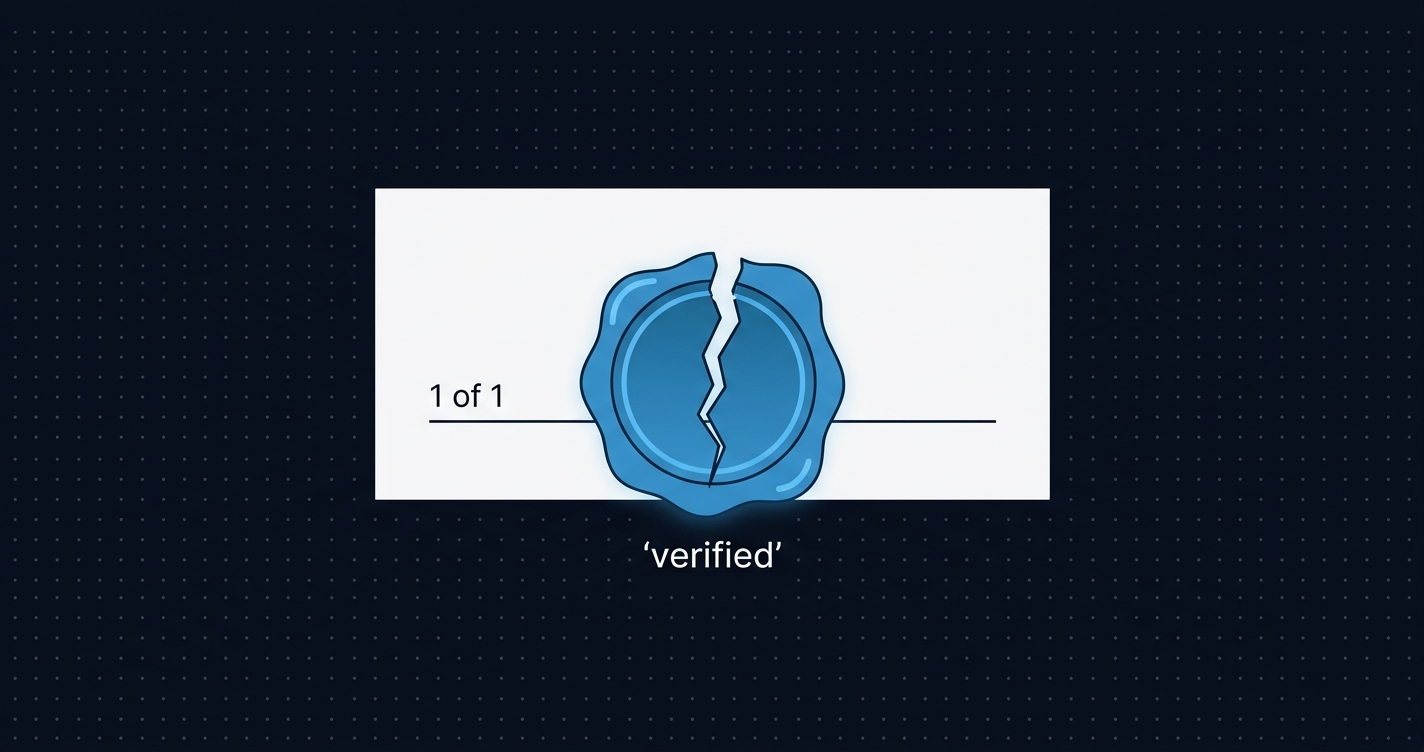
An auditor is three weeks into reviewing a cross-chain bridge. Slither runs clean. Echidna finds no invariant breaks. The team writes a detailed report, the bridge ships, and six months later it gets exploited via a flash-loan-assisted oracle price manipulation.
The post-mortem traces it to a stale price read between check and use, a pattern first documented in 1974 as CWE-367: Time-of-Check Time-of-Use.1
The auditor was not incompetent. The auditor was working with a vocabulary that made it harder to recognize what was happening.
A March 2026 survey of 235 papers on transactional system security found that 66% of all research in the space is focused on blockchain and DLT, yet the attack patterns that dominate DeFi exploits map almost entirely to Common Weakness Enumeration entries documented across four decades of distributed systems and database research.2 The DeFi security community has been conducting its own private retrospective, one expensive post-mortem at a time.
Four generations of transactional systems
The survey, by Sky Pelletier Waterpeace and Nikolay Ivanov at Rowan University, frames the problem through a four-generation taxonomy of transactional systems.2
| Generation | Type | Era |
|---|---|---|
| I | Centralized databases | 1960s-1980s |
| II | Distributed databases | 1980s-2000s |
| III | Distributed ledgers (blockchain/DLT) | 2009-present |
| IV | Multi-context transactional systems | Emerging |
Generation I is where ACID was invented. Atomicity, Consistency, Isolation, Durability, formalized as the guarantees a transaction must provide. The isolation levels in SQL (READ UNCOMMITTED, READ COMMITTED, REPEATABLE READ, SERIALIZABLE) were defined in 1975 precisely because concurrent-access race conditions were destroying database correctness.3
Generation III brought smart contracts, DeFi, and a new explosion of security literature, most of it written as if Generations I and II had not happened.
The survey introduces RANCID as an extension of ACID that covers what modern transactional systems actually require:
| Letter | Property | Description |
|---|---|---|
| R | Real-timeness | Hard/soft timing constraints (block timing, MEV windows) |
| A | Atomicity | Complete-or-nothing across all contexts |
| N | N-many Contexts | Coordination across N>=2 heterogeneous systems |
| C | Consistency | Business-logic invariants preserved |
| I | Isolation | Concurrent transactions don’t interfere |
| D | Durability | Committed effects persist |
Real-timeness and N-many Contexts are the additions. The survey found they are relevant to 73% and 85% of curated papers respectively, and co-occur in 71%. DeFi is already a Generation IV problem (cross-chain bridges, oracle integrations, multi-protocol composability) but most security tooling and vocabulary still treats it like Generation III.
The attack map
Across 163 in-scope papers, the survey identified 61 unique CWE entries. Five of them account for most of what DeFi security teams encounter every day.
Reentrancy -> CWE-362 (Race Condition)
The DAO hack in 2016 is the canonical example. A reentrant call withdraws funds before the balance state is updated, allowing repeated drains. What made it a “smart contract vulnerability” was the EVM execution model. What made it possible was a concurrent-access race condition, the same class of problem that drove the design of isolation levels in relational databases half a century earlier.
Solidity’s checks-effects-interactions pattern is a 50-year-old concurrency solution with a new name.4
Front-running / MEV -> CWE-367 (Time-of-Check Time-of-Use)
TOCTOU was formally documented by McPhee in 1974 in operating system security literature.2 An attacker observes a state check, then acts between the check and the use of that state.
In the Ethereum mempool, the check is the pending transaction’s intended trade. The use is its execution. The public mempool is a globally readable lock state, structurally equivalent to the shared filesystem vulnerabilities that TOCTOU was coined to describe. A sandwich attack is TOCTOU with an MEV bot as the attacker.
Flash loans -> CWE-1229 (Creation of Emergent Resource) + CWE-362
Flash loans create a resource (massive capital) that only exists within an atomic transaction. The survey marks this as one of the few Generation III-specific vulnerability classes with no direct predecessor in Generation I or II systems.2 That’s genuinely interesting: in a field full of rehashed patterns, flash loans are actually novel. The emergent capital enables attacks that look indistinguishable from normal capital allocation until you inspect the full trace. Compound with a race condition (the oracle price read that happens during the loan) and you have most of the DeFi exploit playbook from 2021-2024.
Oracle manipulation -> CWE-367 (Time-of-Check Time-of-Use)
The stale-price problem. A protocol reads the oracle at block N and uses the price to calculate collateral in the same block. An attacker with flash loan capital manipulates the pool price between oracle update and consumption.
function borrow(uint256 amount) external {
    // CWE-367 CHECK: oracle price read
    uint256 price = oracle.getPrice(token);
    uint256 collateralRequired = amount * price / 1e18;

    // attacker manipulates pool price between these two lines

    // CWE-367 USE: collateral validation against now-stale price
    require(collateral[msg.sender] >= collateralRequired);
    _executeLoan(msg.sender, amount);
}
Same CWE as front-running. Different surface, same structural failure.
Cross-chain bridge exploits -> CWE-841 (Improper Enforcement of Behavioral Workflow)
A finalized transaction on Chain A is trusted by Chain B before the finalization guarantee is actually honored. The bridge workflow (finalization -> relay -> mint) has a broken invariant at the cross-chain seam. The Ronin bridge attack in 2022 ($625M), the Wormhole attack ($320M), the Nomad bridge attack ($190M): all share this structure.5 A behavioral workflow with a compromised step at the seam between systems.
Why this matters for auditors
Knowing the CWE category for a vulnerability class is not just taxonomic tidiness. It has practical consequences for audit scoping and tooling selection.
Audit scope gets bounded. A checklist of “Solidity vulnerabilities” is open-ended, since new DeFi primitives surface new patterns regularly. A CWE-based checklist is bounded, maintained by MITRE, and cross-referenced against decades of prior research. The 61 CWEs identified in 163 transactional papers represent a finite search space, not an expanding frontier.
Tool selection gets clearer. Slither, Mythril, and Echidna are built for Generation III implementation-level bugs, code patterns and constraint violations. The most expensive exploits of 2024-2025 were composition-level failures: two individually correct components producing incorrect combined behavior. That maps to Generation IV threat models, specifically CWE-1229 (emergent resource creation) and CWE-841 (workflow enforcement failures across system boundaries). No current static analyzer is designed for this class.
Post-mortems become cross-referenceable. DeFi post-mortems are written in DeFi-native vocabulary: “flash loan attack,” “oracle manipulation,” “sandwich attack.” They do not cross-reference the prior incident that used the same underlying pattern. The Wormhole post-mortem does not cite the Ronin post-mortem, even though both are CWE-841. That’s not a coordination failure; it’s a vocabulary problem. An auditor reviewing a new bridge in 2026 does not automatically inherit the lessons from 2022 because the shared vocabulary does not exist in the reports. RANCID’s practical proposal: map every audit finding to a CWE entry before publishing.
| DeFi Attack Pattern | CWE | Class | First documented |
|---|---|---|---|
| Reentrancy | CWE-362 | Race Condition | 1970s (concurrent DB systems) |
| Front-running / MEV | CWE-367 | TOCTOU | 1974 (McPhee) |
| Flash loan + oracle | CWE-367 + CWE-1229 | TOCTOU + Emergent Resource | 1974 (CWE-367); Gen III new (CWE-1229) |
| Oracle price manipulation | CWE-367 | TOCTOU | 1974 (McPhee) |
| Cross-chain bridge exploit | CWE-841 | Behavioral Workflow Failure | Distributed systems era |
| Double-spend | CWE-294 | Capture-Replay | Byzantine fault tolerance research |
The survey also found CWE-385 (Covert Timing Channel) appearing in 3 papers and CWE-290 (Authentication Bypass by Spoofing) in 5, both with roots in 1980s OS and network security literature.2
What the on-chain trace tells you
When a TOCTOU exploit happens, the attack sequence is in the trace. The oracle read is a specific call at a specific position in the transaction. The pool manipulation is a preceding transaction in the same block. The collateral check that follows is the use step.
A block explorer that renders decoded call trees and state changes (including internal calls and the sequencing within a block) maps directly to the CWE-367 attack structure. The oracle price read is the CHECK. The pool manipulation in the same block is the TOCTOU window. The collateral validation is the USE. Every piece of the pattern is in the trace; what’s been missing is the vocabulary to recognize it as a known attack class rather than a novel one.
For post-incident forensics, this distinction matters. A team that identifies an exploit as CWE-367 can immediately pull 50 years of prior research on TOCTOU mitigations: time-of-use validation, TWAP oracles with bounded observation windows, multi-block finality checks, rather than treating the mitigation as a first-principles design problem.
Ethernal’s transaction tracing renders the full call tree and state transitions for any EVM-compatible chain, exactly the data needed to reconstruct the sequence. Transaction tracing with Ethernal covers the mechanics.
The same attacks, better labeled
The survey’s core finding is not that DeFi is uniquely insecure. It is that DeFi security research is operating in a siloed bubble, producing terminology that obscures the structural commonality with decades of prior work. 66% of transactional security literature focuses on Generation III systems. Most of it does not cross-reference the Generation I and II research that already classified the underlying attack patterns.
The argument is not that DeFi engineers need to read 1970s database papers. It is that the structured vocabulary already exists (61 CWEs across 163 papers) and adopting it costs almost nothing. Map the next audit finding to a CWE before publishing. Cross-reference the prior work. The bridge team that inherits a CWE-841 tag on an incident report gets to start from 40 years of workflow enforcement research, not from zero.
References
1. MITRE. “CWE-367: Time-of-check Time-of-use (TOCTOU) Race Condition.” cwe.mitre.org. https://cwe.mitre.org/data/definitions/367.html
2. Waterpeace, S.P., Ivanov, N. “SoK: Evolution, Security, and Fundamental Properties of Transactional Systems.” arXiv, March 10, 2026. https://arxiv.org/abs/2603.07381v1
3. ANSI. “SQL Isolation Levels.” ANSI X3.135, 1975. (Cited via ISO/IEC 9075 SQL Standard documentation.)
4. MITRE. “CWE-362: Concurrent Execution Using Shared Resource with Improper Synchronization (‘Race Condition’).” cwe.mitre.org. https://cwe.mitre.org/data/definitions/362.html
5. MITRE. “CWE-841: Improper Enforcement of Behavioral Workflow.” cwe.mitre.org. https://cwe.mitre.org/data/definitions/841.html